Maintenance that starts when the machine stops
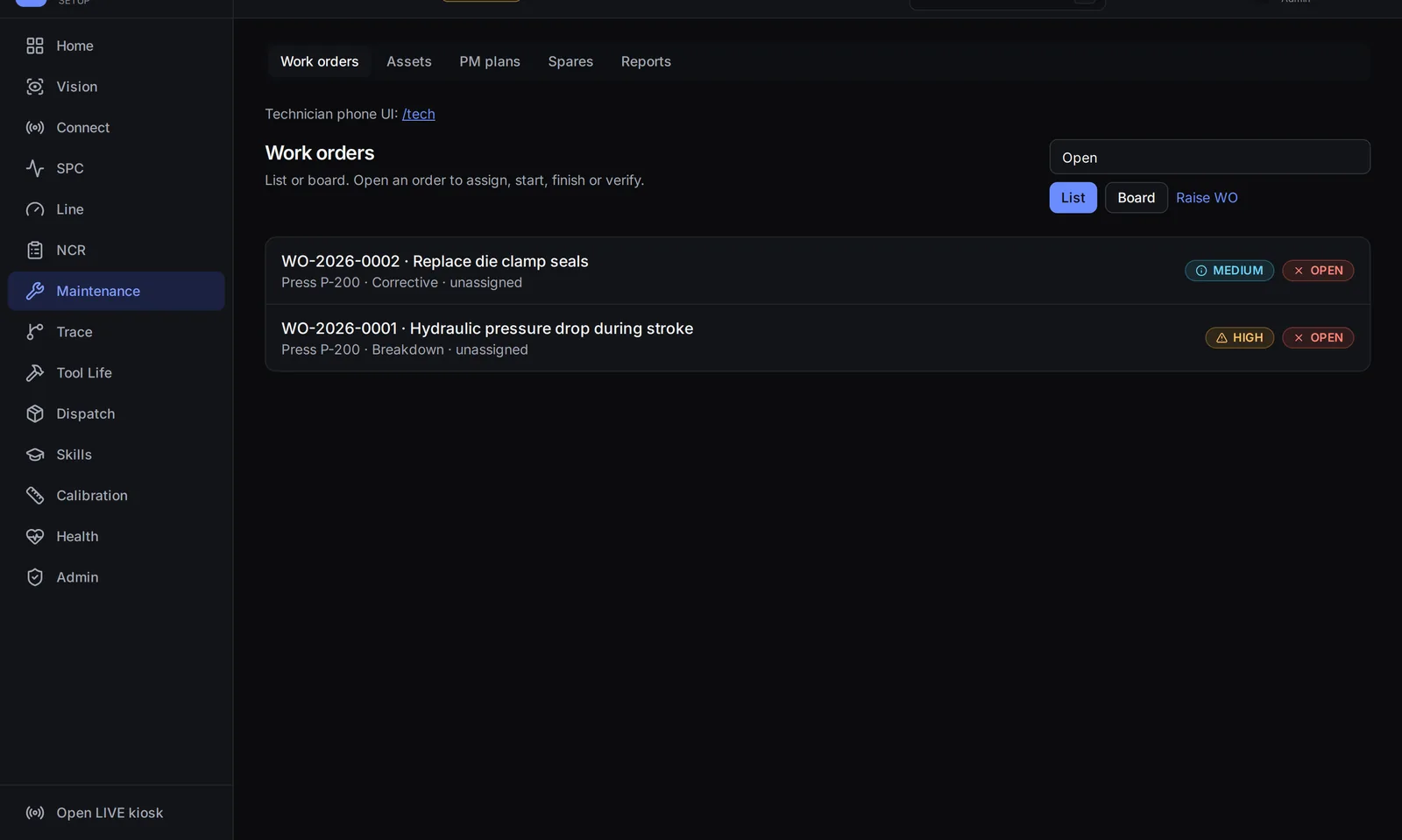
Get machines fixed faster, and service them before they break. A breakdown can open a work order by itself, planned servicing is scheduled automatically, and technicians work from a simple page on the shop floor.
Breakdowns are reported by phone, PM is tracked on paper, and the spare part is never in stock when it is needed.
Built and tested in software, not yet proven on a plant line. Available to pilot plants.
Maintenance, step by step
- A machine stopsAn operator presses the Andon on Press 3, or Line Performance records the downtime.
- The order opens itselfA breakdown work order opens, linked to that stop. A second signal for the same stop joins it instead of opening another.
- A technician takes itOn a phone or tablet, even without network. Changes made offline show as pending until they are sent.
- Done, with the action takenEvery required checklist item is ticked and the action taken is recorded.
- VerifiedPress 3 is safety-critical, so the order closes only when a supervisor verifies it.
Step 1 of 5 · Example order
What Maintenance does
Breakdowns open themselves
An Andon call, a downtime or a PLC fault signal opens a work order. One stop is one order.
Preventive maintenance
PM plans by calendar, usage or condition, with a tolerance window, checked automatically.
Spares
A spares register with stock moves. Stock can never go below zero.
Technician page
Works offline on a phone or tablet and can be installed like an app. Queued changes show as pending.
Safety-critical assets
Their orders close only when a supervisor verifies them.
Ready to share
Period report in PDF and Excel.
What changes with Maintenance
Breakdowns logged automatically
An Andon call, a recorded stop or a machine fault signal opens the order.
Planned maintenance on time
Plans by date, by usage or by condition, checked automatically.
Spares under control
Stock moves recorded, and stock can never go below zero.
Works on the shop floor
The technician page works offline on a phone or tablet.
Safe sign-off
Work on safety-critical machines closes only after a supervisor verifies it.
Built to stay honest
These rules are part of the app, not settings.
- One breakdown source per site, so one stop never opens two orders.
- Putting an order on hold, cancelling or reopening it needs a reason.
- Finishing needs every required checklist item and, for a breakdown, the action taken.
- Closed orders are read-only.
Works with
- Same login, roles and audit trail as every Gorad app
- Runs inside your plant, with offline licensing
- Work order
- A job for the maintenance team, with what to do, who does it and what was done.
- Preventive maintenance
- Planned servicing done before something fails, based on time, usage or condition.
- Breakdown
- An unplanned stop because a machine failed.
- MTBF / MTTR
- Mean time between failures and mean time to repair: how often a machine breaks down, and how long it takes to fix.
- Safety-critical asset
- A machine where a mistake in maintenance could hurt someone, so the work needs a second sign-off.
About Maintenance
How are breakdown orders created?
From Line Performance (an Andon call or a recorded stop), or from a machine fault signal through Gorad Connect. Each site picks one source, so one stop never opens two orders.
Do we need Line Performance?
No. Without it, breakdowns can come from a fault signal through Connect, or orders can be opened by hand.
Can technicians work without network?
Yes. The technician page works offline and shows changes as pending until they are sent.
What kinds of preventive maintenance are supported?
Calendar plans, usage plans (for example running hours or strokes) and condition plans, each with a tolerance window.
See Maintenance with your data
Tell us how you handle this today, and we will show you how Gorad Maintenance would fit.