Statistical process control that fills itself
Know when a process starts to drift, before it makes bad parts. Measurements arrive by themselves from your cameras and machines, or are typed in, and the app warns you within seconds when a process leaves its limits.
Measurements sit in spreadsheets and gauges, charts are drawn after the fact, and a drift is found when the parts are already made.
Built and tested in software, not yet proven on a plant line. Available to pilot plants.
SPC, step by step
- Readings arrive by themselvesMeasurements come from Vision, Connect or a gauge. Each subgroup is plotted the moment it completes.
- Judged against locked limitsEvery point is checked against the locked limits and the rules you enabled.
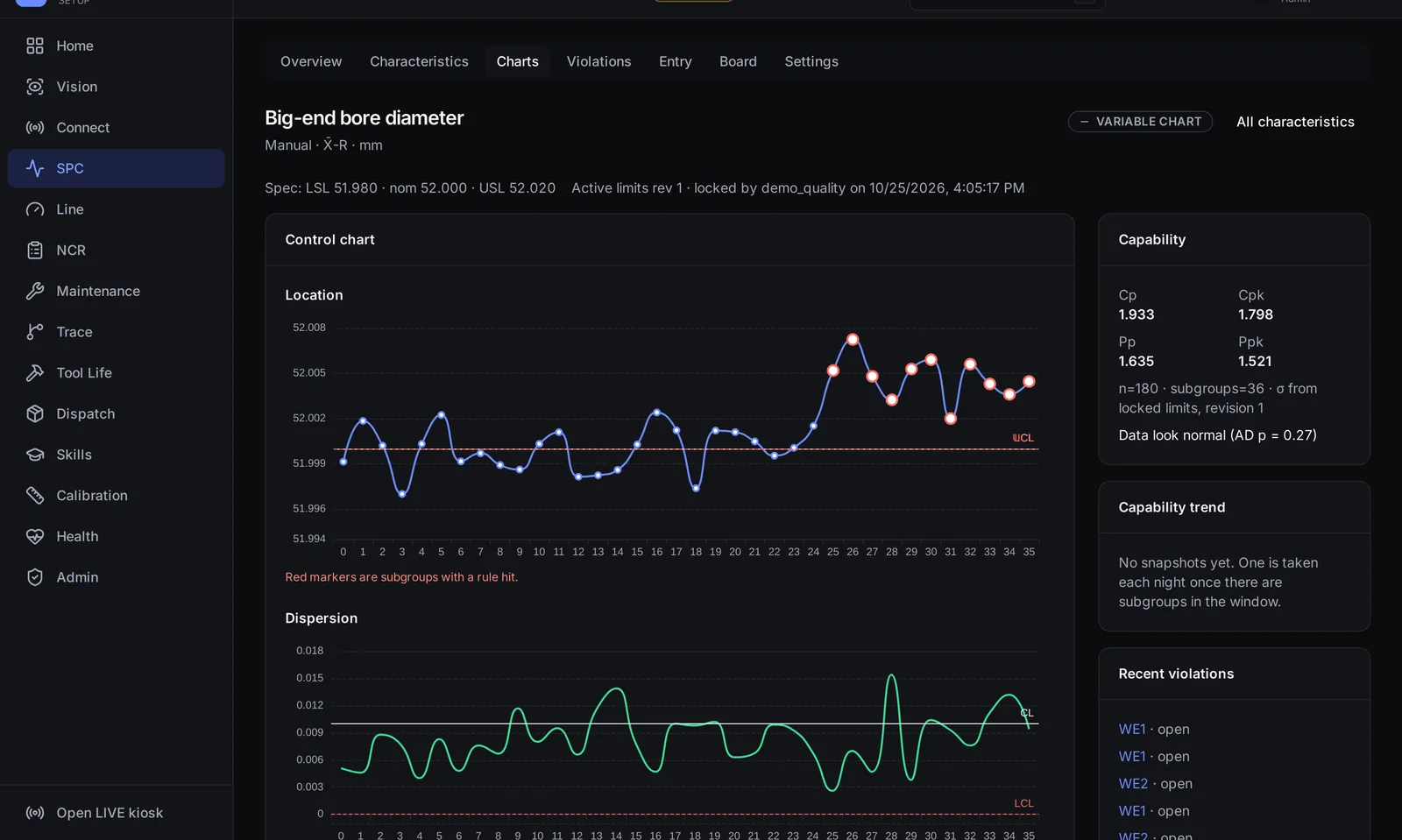
- A pattern appearsNine points in a row sit above the centre line. No point is outside the limits, but the process has shifted.
- The rule firesSPC flags the violation within seconds and notifies the right people.
- Acknowledge and actQuality acknowledges it with a cause and an action, and can raise an NCR in one step.
Step 1 of 5 · Example values
What SPC does
Data arrives by itself
Vision measurements and verdicts, Connect tags and manual gauge readings feed the same characteristics.
The charts you expect
Variable, attribute and defect charts (R, S and MR dispersion; p, np, c and u), EWMA, CUSUM, and short-run DNOM and Z-MR.
Rules in seconds
Each subgroup is judged as soon as it completes, with Western Electric 1–4 and Nelson 1–8 rules.
Locked limits
Limits are previewed, then locked by quality with a reason and re-authentication. Every lock is a new, audited revision.
Capability
Cp, Cpk, Pp and Ppk with 95 % intervals and a normality test, with a warning when there is too little data.
Act on violations
The right roles are notified, acknowledge with a cause code and an action, and can raise an NCR in one step.
Ready to share
Characteristic report and audit pack.
What changes with SPC
Catch drift before scrap
A shift in the process is flagged while parts are still good.
No manual charting
Measurements arrive from inspection, machines or gauges by themselves.
Ready for audits
Locked limits, every revision recorded, and an audit pack per characteristic.
Know your capability
Cp and Cpk with confidence intervals, so you know how good the process really is.
Act straight away
The right people are notified, and an NCR is one step away.
Built to stay honest
These rules are part of the app, not settings.
- Nothing is judged until limits are locked.
- A subgroup never spans a program version or a shift change.
- A short-run reading for an unknown part is refused, never guessed.
- SPC only reads published results. It never touches the inspection path.
Works with
- Same login, roles and audit trail as every Gorad app
- Runs inside your plant, with offline licensing
- SPC
- Statistical process control: charts that watch a measurement over time and warn you when the process starts drifting, before parts go out of tolerance.
- Control limits
- The boundaries of normal variation for a process, calculated from its own data. Points outside them, or odd patterns inside them, mean something has changed.
- Subgroup
- A small group of measurements taken close together and plotted as one point on a control chart.
- Nelson rules
- Standard patterns that signal a process change, such as nine points in a row on one side of the centre line. Western Electric rules are a similar, older set.
- Cp / Cpk
- Capability indexes: how comfortably the process fits inside its tolerance. Above 1.33 is a common target.
- EWMA / CUSUM
- Control charts that are especially good at spotting small, slow drifts.
About SPC
Do we have to enter measurements by hand?
No. Measurements from Gorad Vision and machine values from Gorad Connect arrive automatically. Manual entry is there for hand gauges.
Which rules does it check?
Western Electric rules 1–4 and Nelson rules 1–8 on the main chart, plus EWMA and CUSUM charts for small, slow shifts.
Can anyone change the control limits?
No. Quality locks the limits with a reason and by confirming their password. Each lock is a new, recorded revision.
We make many part numbers in short runs. Does SPC still work?
Yes. Short-run charts (DNOM and Z-MR) let different part numbers share one chart against their own nominal values.
See SPC with your data
Tell us how you handle this today, and we will show you how Gorad SPC would fit.